.jpg)
Beam me up Scotty - 3D Printing in Space
- mcclements
- Nov 20, 2020
- 3 min read
by Amanda Chin

Science fiction has brought many of the concepts that people dream of. However, now that we have a better understanding of science, we can take the concepts in theory and put them into practice. One of these examples is Star Trek and the food replicator. The basic concept of this science fiction machine was to convert matter into fresh food for the space crew to eat. This is seen as important because the current space food in the modern world is bland, bulky, and dehydrated. Why is this important? How can science do this? What steps do we need to take to get there?

Why is space food important? This is important for many reasons actually. Food in space has to be lightweight, compact, and storable in the months of travel. This is important because managing space travel is complicated. It is traveling with the same crew till the end. Not only managing storage space, but also the morale of the crew. A crew with good morale is better for space travel, due to the fact that they are living together for an extensive duration of time. One of the biggest problems astronauts have is the lack of good and diverse food. Food is the base of all humans and leaving freshly prepared meals is hard for a lot of people. The stomach creates a lot of hormones that relate to moods, like serotonin and dopamine. Therefore, lack of a “good” meal really hits people hard, when traveling for so long. Even when the food may be delicious, the amount of diversity of meal choices can be limiting due to the available capacity of storage space.
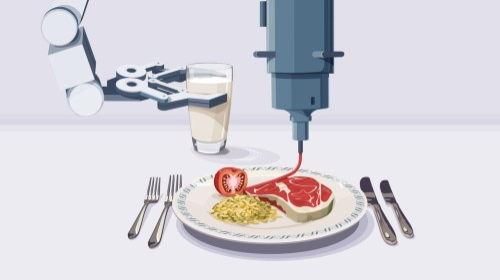
This problem can be fixed through our science fiction invitation of the food replicator. However, since converting matter is something still outside of the scope of what science can do, as of now. There is a solution to this problem, which is 3D printing. 3D printing is the construction of a 3D object, via using a computer model. 3D models can be developed through a computer-aided design software or CAD which would then be spliced into layers for a printer to recognize. Currently printers are mainly being used to print polymers in construction, prototyping, and simply DIY. How can this be helpful? Well, there is a lot of research going into replacing the polymers with different filaments that are edible. Printing edible materials isn’t an easy task like current polymers as the material. The machine itself has to be working in not only a standard environment, but also in a zero-gravity environment. Theoretically, these would taste better and still have vitamins and nutritional value.

So, what does this mean? How do we take the concepts of 3D printing and turn them into food? This is based on the research, type of machine, filament, 3D printability, tastes, and contents of health. The machine itself comes with some challenges, printing anything from scratch takes time and energy. It also has to be usable and easily broken down in order to be regularly cleaned for a typical user. If the machine ever broke in space it could then be easily broken down to repair or cleaned, or else there would be a major problem. As stated before, the machine has to work in the environment that it is in, so printing in 3D might lead to some challenges.
For the filament, there are multiple filaments being tested. This is due to the fact that different filaments have different properties. Different filaments have different textures like: hardness, adhesiveness, resilience, cohesiveness, etc. However, they are also looked through for their rheological characteristics, since the viscosity, shear rate, and temperature need to work with the machine. This is due to the fact that filament is usually starting in the solid-state (or paste-like), melted into a liquid, and then set back into a solid. This has to dry quickly enough to be stable to build on top of it. The strength of the material will affect the structure of the model and as some filaments might hold the shape of the print better than the others. Also, the filaments have controlled allergens. This means that we can have replacements for certain foods, yet it can be allergen free or very close to it.
Lastly, before getting 3D printing into space, science would also have to make the food taste good, sustainable, and affordable. This would have to be done through human trials. After they pass all of this research, this could be used for space. After this and more refinement, this could be used for home use as well. Beam me up scotty!


Comments