.jpg)
Advances in sensory analysis. Spoiler alert: this is science fiction.
- mcclements
- Nov 22, 2020
- 7 min read
Maija Greis, Erin Short, and Allison Cox imagine what sensory analysis of foods will look like in the future.
Interview with Dr. Brown.
October 15th 2085, Boston.

Hello, Dr. Brown, Could you tell us something about yourself, where do you work and what kind of things are you working with?
I work at a company called NeatMeat in a cross-modal laboratory. We produce old fashioned style meat and dairy products from non-meat ingredients for all consumers, but particularly consumers with taste disorders. I am a sensory scientist and I work with electronic tongues and noses. I graduated from the world famous UMass Amherst Food Science Department in ‘55. Oh, 30 years ago. Time really flies!
Tell me about it! Could you tell us, how do the electronic tongue and nose work?
These instruments use a variety of technologies to ultimately imitate the human nose and tongue. They are made of a series of sensors connected to a computer with an artificial intelligence system to determine the arrangement of molecules.
For the electronic mouth, we use a 3D biometric mouth and tongue surface that replicate the topography and wettability of a real human mouth. The basic taste receptors (sensors) are placed around the mouth and tongue as well as tactile sensors which perceive the temperature and other tactile properties. With the software attached to the electronical mouth we can also adapt the oral processing style, tongue movements, and eating rates in any way we want. It gives us basically endless possibilities to study human senses and sensory properties of food.
For the electronic nose, the software basically plays the role of the brain. In humans, the olfactory system sends signals to the brain which interprets the odors based on previous experiences. However, for the electronic nose, the sensors capture signals and send them to software which will estimate the volatiles and complex gas combinations rather than determining the chemical compounds separately.
The nose and mouth are connected with the same software, the brain of our robot. We can then easily control which sense (specific taste or flavor compound) we omit from the experiment and see how it affects the overall perception.
How did you become interested in sensory science?
This area is so fascinating, it keeps evolving all the time. The food we all eat has changed enormously during the last 100 years. As food and sensory scientists, we need to keep track of current consumer behavior and preferences. And most importantly, we need to be ahead of time. We need to know what is coming.
As you know, there have been some major discoveries in the field during the last 10 years. For a long time we’ve had this idea that humans have only five basic tastes. We now have a very detailed picture of the human tongue with at least 12 known basic tastes that are perceived in the mouth.
Another, perhaps unfortunate reason, is the increasing amount of epidemic diseases facing us and as we know some of them have stayed on the planet for a long time. Each one has had different properties and most of them have had an impact on our senses. There is a demand to better understand the way they affect our eating habits and what we can do to minimize the harm or even prevent their ability to deteriorate our senses, like smell.
What kind of products do you work with?
Supringinsly, consumers are very interested in old-fashioned meat and dairy-like products now. We have our own laboratory where we develop dairy and meat protein analogues. For meat specifically, we have replicated the same protein and fat structures that make up different muscle groups of the animal yet they are all made up of a mix of plant-based materials. Some ingredients are made out of microbes by fermentation and some of them are purely plant-based. They are all vegan, for sure.
Take cows for example, we have been able to mimic the exact texture, flavor and appearance of each individual muscle group of the animal. Our success isn’t limited to one specific animal or class, we have also been able to do this for commonly consumed creatures, for example: all bovine animals, all fowl, including game, pigs, sheep and goats. We initially started out with the most consumed animal in each category and then innovated and diversified our options. While we have quite the selection of sea animals, salmon and tuna, sardines and anchovies, crab, shrimp and lobster etc. specifically octopus has been the most challenging- and don’t even get me started on bivalves.
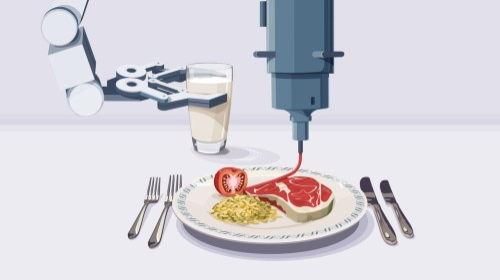
Our company also produces valuable plant-based ingredients for domestic use, particularly for 3D printers.
What kind of problems do you solve in your work?
The history of building robot mouths is long and it has not been an easy task. However, now that we have a true representation of actual oral conditions and mechanisms, we can focus on designing healthy and tasty food products that focus on enhancing just specific tastes or flavors.
Also, at the moment we have started to understand how different diseases (e.g. viruses, cancer) affect sensory perception. The challenge is to mimic the same perception with our electronic tongue and nose.
Describe one thing you are very proud of in your work?
Our electronic tongues have already helped develop tasty foods for people with taste disorders: These electronic tongues have been able to become so advanced that you can set different parameters to mimic a human cancer patient’s taste buds and how they have morphed and changed due to chemotherapy. With these parameters, we’ve been able to create food that is flavored differently taking into consideration the perfect balance of somatosensory, ‘sensory integration’ or ‘multi-modal perception’, and fully understand the mechanism behind taste cell deterioration due to different illnesses.
I am also very impressed with all of the expanding knowledge and analytical tools on the systems that determine how food is broken down in the mouth and tongue dynamics. This knowledge has been very important in replicating the texture of our products. It has allowed us to quickly create new varieties of products. Replicating the exact texture of meat in meat analogues was one of the greatest challenges for a long time.
What advancements/trends in food products do you find the most exciting?
It looks like the current trends are the conventional ways of cooking. People have started to use the oven and stove again now that the electricity is affordable. We try to consider that fact when developing new products.
Not specific to food products - but the usage of virtual and augmented reality is really starting to be used. These technologies started to be used years ago but are really starting to take off now. There was a quick shift to solving sustainable issues in the food industry and now consumer acceptance is becoming increasingly important for all of our highly innovative products. Using sensory booths has benefits but is not representative of the environment in which food is typically consumed. It is also becoming more popular to use brain measurements to determine people’s emotions as well. We have found that using liking and rating scales has many flaws and using measurements of the brain provides the most accurate results and can help determine any biases people have to the products.
Who do you work with?
In addition to our electronic tongues and nose, we have 12 panelists in our human sensory panel. I also work with other food scientists, nutritionists, physicists, chemists and statisticians, medical doctors, food architects and designers. We are all specialists in a very small area. Although, I feel that nowadays we all need to have a broad understanding of social sciences as well.
And of course there are a bunch of robots working with us. We all have at least one robot as an assistant. They still haven’t taken our jobs.
So, you are still using human panelists?
I hear that question all the time. It might sound a bit old-fashioned, but yes we do use human panelists. The tongues do make my work easier, faster and you can rely on the results they give you. I still, however, need the human panelists sometimes to calibrate the tongues into different moods (tired, anxious, happy, relaxed, joyful) and into specific taste disorders so we can target our foods in a better way. And with completely new food products, I need the human panelists to rate the overall-liking of the test products. You know, at the end of the day, humans eat our products, not robots.
What do you think is the biggest challenge facing our food system today?
Well, the same answer as they said already years ago. The too warm and unstable weather around the globe and the global pandemics. These do not only affect the ways food is produced but also the way people consume their food. The biggest challenge is that it is more and more difficult to predict.
We have seen a lot of progress on the production side in making more sustainable food. However, it is really important for consumers to continue to change their dietary habits which is a difficult task. I have found an interest in the consumer science side of sensory science trying to learn how to accomplish this task. We can continue to advance food in more sustainable ways, but if consumers won’t eat it then how much is it really helping the environment?
Ultimately, we need to figure out how to increase willingness to try and create positive expectations. Then, those expectations need to be met or exceeded for people to regularly consume them. This would also include improving consumer trust and acceptance of sustainable and technological advances as well as increasing the acceptance and liking of more diverse foods while decreasing skepticism and neophobia. The acceptance of diversity in foods could include trying new crops, especially crops that are in season in their location, but also be more accepting of new flavors and appearance. Improving acceptance of different appearances can also help tackle food waste issues especially if combined with greater education on food safety practices. Sensory science can also help to decrease disgust factor of waste-to-value food products.
Where do you see yourself progressing in the world of ‘Future Foods’?
People have started to be very excited about extinct animal lab meat. We are now able to produce lab grown mammoth meat from the frozen mammoth fossils found in Siberia. I think this is something I could see myself doing in the future.
That is fascinating for sure. Thank you for your time Dr. Brown and all the best in the future.
Thank you.
References:
Andablo-Reyes, E., Bryant, M., Neville, A., Hyde, P., Sarkar, R., Francis, M., & Sarkar, A. (2020). 3D Biomimetic Tongue-Emulating Surfaces for Tribological Applications. ACS applied materials & interfaces.
Aschemann-Witzel, J., Ares, G., Thogersen, J., & Monteleone, E. (2019). A sense of sustainability? - How sensory consumer science can contribute to sustainable development of the food sector. Trends in Food Science & Technology.
Menis-Henrique, M. E. C. (2020). Methodologies to advance the understanding of flavor chemistry. Current Opinion in Food Science.
Panda, S., Chen, J., & Benjamin, O. (2020). Development of model mouth for food oral processing studies: Present challenges and scopes. Innovative Food Science & Emerging Technologies, 102524.
Pérez-Ràfols, C., Serrano, N., Ariño, C., Esteban, M., & Díaz-Cruz, J. M. (2019). Voltammetric electronic tongues in food analysis. Sensors, 19(19), 4261.


Comments